
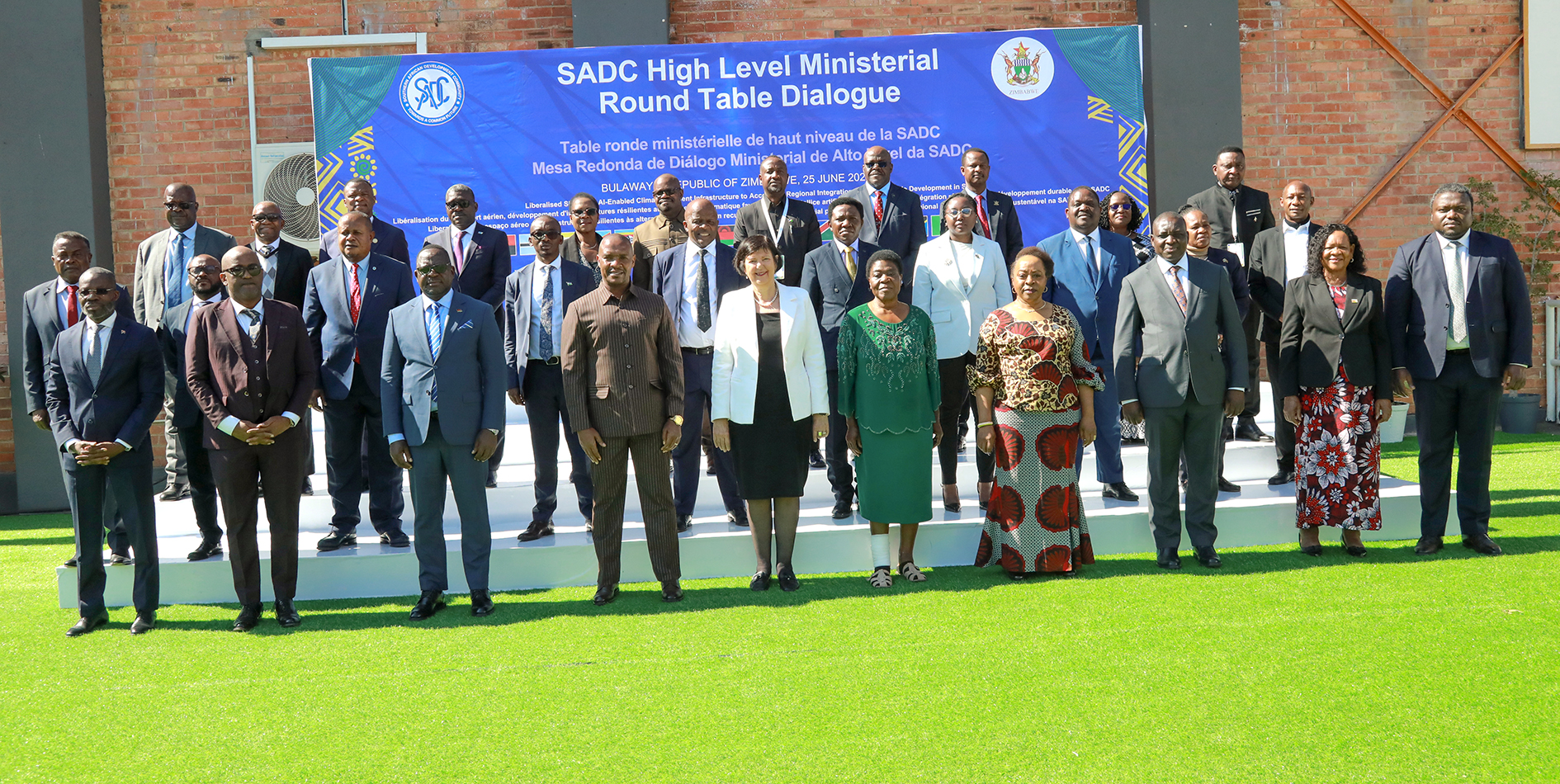
The Southern African Development Community (SADC) convened a High-Level Ministerial Round Table Dialogue in Bulawayo, Republic of Zimbabwe, on 25 June 2026 under the theme: “Liberalised Skies and Artificial Intelligence (AI)-Enabled Climate-Resilient Infrastructure to Accelerate Regional Integration and Sustainable Development in SADC.”
Organised by the SADC Secretariat in collaboration with the Government of Zimbabwe as the host Government, with the support of the Republic of South Africa in its capacity as the Interim Chair of SADC, the Dialogue brought together Ministers, senior government officials, regulators, development partners, industry leaders and international experts to deliberate on strategic priorities for advancing regional integration, connectivity and sustainable development across the SADC Region.
The Dialogue was convened on the margins of the SADC Cluster Meeting of Ministers Responsible for Transport, Information and Communication Technologies (ICT), Information and Meteorology, scheduled to take place in Bulawayo on 26 June 2026. The Cluster Meeting will deliberate on strategic priorities aimed at strengthening regional infrastructure, enhancing connectivity and promoting sustainable development across the SADC Region.
Honourable Barbara Creecy, Minister of Transport of the Republic of South Africa, underscored the importance of deepening regional cooperation and accelerating initiatives that strengthen connectivity, economic integration and resilience. She called upon Member States to work collectively to advance the liberalisation of African skies, promote seamless mobility, invest in modern and climate-resilient infrastructure and harness innovation and emerging technologies to drive inclusive and sustainable socio-economic development.
Minister Creecy further emphasised the need for coordinated regional action to address the growing impacts of climate change, strengthen disaster preparedness and ensure that all Member States benefit from the opportunities presented by digital transformation and emerging technologies.
Honourable Judith Ncube, Minister of State for Bulawayo Provincial Affairs and Devolution of the Republic of Zimbabwe, emphasised the critical role of transport in advancing regional integration. She stated that the transport sector remains a cornerstone of SADC’s regional integration agenda, serving as the physical and economic bridge that connects our people, markets and industries. Efficient, safe and climate-resilient transport systems are essential for facilitating trade, reducing the cost of doing business and improving the movement of people and goods across our borders.” Minister Ncube urged stakeholders to remain guided by “the principles of solidarity, mutual benefit and shared prosperity that have defined SADC.”
Mrs. Angele Makombo N’tumba, SADC Deputy Executive Secretary for Regional Integration, highlighted the strategic importance of aviation connectivity for regional integration and economic development. She noted that for SADC, enhanced aviation connectivity extends beyond the movement of people; it is equally about enabling the efficient flow of goods, services, skills, investment and opportunity across the region.
She further observed that the region continues to experience increasing exposure to extreme weather events, including floods, droughts, cyclones and other climate-induced disruptions. These events, she said, have significant implications for transport corridors, airports, logistics systems, communication networks and essential public services.
The Dialogue featured two plenary sessions that provided a platform for Ministers, policymakers, regulators, industry representatives and development partners to exchange experiences, share knowledge and explore practical solutions to regional challenges.
Discussions focused on accelerating the implementation of the Single African Air Transport Market (SAATM), enhancing aviation connectivity, improving air transport affordability and promoting investment in transport and aviation infrastructure.
Ministers emphasised that stronger air connectivity is essential not only for facilitating the movement of people, but also for expanding trade, tourism, investment and the movement of goods and services across the region. Deliberations also examined how Artificial Intelligence (AI), Digital Public Infrastructure (DPI), and emerging technologies can be leveraged to improve efficiency, strengthen service delivery, enhance regional interoperability and support sustainable economic growth.
The Round Table further highlighted the critical role of meteorological services, climate information systems and early warning mechanisms in strengthening infrastructure resilience, enhancing aviation safety and supporting disaster preparedness. The dialogue explored opportunities for applying AI in climate forecasting, disaster risk management, predictive maintenance and transport operations, while also considering issues related to governance, ethics, regulation and cybersecurity.
It provided a valuable platform for the exchange of experiences, best practices and innovative approaches among Member States and stakeholders on issues shaping the future of transport, aviation, ICT and meteorology in the region.
Deliberations and perspectives shared during the Dialogue were consolidated into a Summary and Conclusions Report, capturing key messages and emerging priorities related to accelerating the implementation of the Single African Air Transport Market (SAATM), the adoption of Artificial Intelligence (AI) and Digital Public Infrastructure (DPI), climate-resilient infrastructure development and the strengthening of meteorological and early warning systems.


